


Innovation Watch - Latest UM Patents (2026-09-21)
A digital driver, feedback circuit for analog-to-digital converter, and digital-to-analog converter [Granted Patent]
數字驅動器、用於模數轉換器的反饋電路、數模轉換器 [授權專利]
Publication No.:
CN114499528B
Publication Date:
2026-09-18
Applicant(s):
澳門大學;珠海一微半導體股份有限公司;珠海澳大科技研究院; University of Macau; Amicro Semiconductor Co Ltd; Zhuhai UM Science & Technology Research Institute (ZUMRI)
Inventor(s):
郭銘強;冼世榮;肖剛軍;趙偉兵;許登科;馬許願; Guo, Mingqiang; Xian, Shirong; Xiao, Gangjun; Zhao, Weibing; Xu, Dengke; Rui Paulo da Silva Martins
Technology Field(s):
基本通訊流程 Basic communication processes
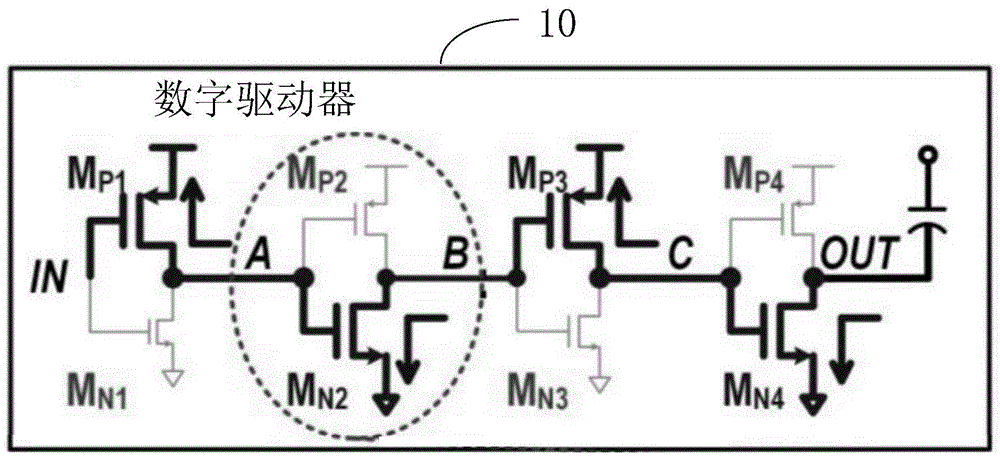
An embodiment of the present application provides a digital driver comprising: an input terminal, an output terminal, first, second, third, and fourth PMOS transistors, and first, second, third, and fourth NMOS transistors. The input terminal is connected to the first PMOS transistor and the first NMOS transistor. The first PMOS transistor, the first NMOS transistor, the second PMOS transistor, and the second NMOS transistor are connected to a first node. The second PMOS transistor, the second NMOS transistor, the third PMOS transistor, and the third NMOS transistor are connected to a second node. The third PMOS transistor, the third NMOS transistor, the fourth PMOS transistor, and the fourth NMOS transistor are connected to a third node. The fourth PMOS transistor and the fourth NMOS transistor are connected to the output terminal. The width of each PMOS transistor and each NMOS transistor is determined according to carrier mobility and a preset scaling-down coefficient. In this manner, the delay time and power consumption can be reduced by adjusting the transistor dimensions using the preset scaling-down factor.
Publication No.:
CN114499528B
Publication Date:
2026-09-18
Applicant(s):
澳門大學;珠海一微半導體股份有限公司;珠海澳大科技研究院; University of Macau; Amicro Semiconductor Co Ltd; Zhuhai UM Science & Technology Research Institute (ZUMRI)
Inventor(s):
郭銘強;冼世榮;肖剛軍;趙偉兵;許登科;馬許願; Guo, Mingqiang; Xian, Shirong; Xiao, Gangjun; Zhao, Weibing; Xu, Dengke; Rui Paulo da Silva Martins
Technology Field(s):
基本通訊流程 Basic communication processes
An embodiment of the present application provides a digital driver comprising: an input terminal, an output terminal, first, second, third, and fourth PMOS transistors, and first, second, third, and fourth NMOS transistors. The input terminal is connected to the first PMOS transistor and the first NMOS transistor. The first PMOS transistor, the first NMOS transistor, the second PMOS transistor, and the second NMOS transistor are connected to a first node. The second PMOS transistor, the second NMOS transistor, the third PMOS transistor, and the third NMOS transistor are connected to a second node. The third PMOS transistor, the third NMOS transistor, the fourth PMOS transistor, and the fourth NMOS transistor are connected to a third node. The fourth PMOS transistor and the fourth NMOS transistor are connected to the output terminal. The width of each PMOS transistor and each NMOS transistor is determined according to carrier mobility and a preset scaling-down coefficient. In this manner, the delay time and power consumption can be reduced by adjusting the transistor dimensions using the preset scaling-down factor.
A wall-climbing robot
一種爬壁機器人
Publication No.:
CN122770845A
Publication Date:
2026-09-18
Applicant(s):
澳門大學; University of Macau
Inventor(s):
徐青松;張宸翰;張偉鍵; Xu, Qingsong; Zhang, Chenhan; Zhang, Weijian
Technology Field(s):
運輸 Transport
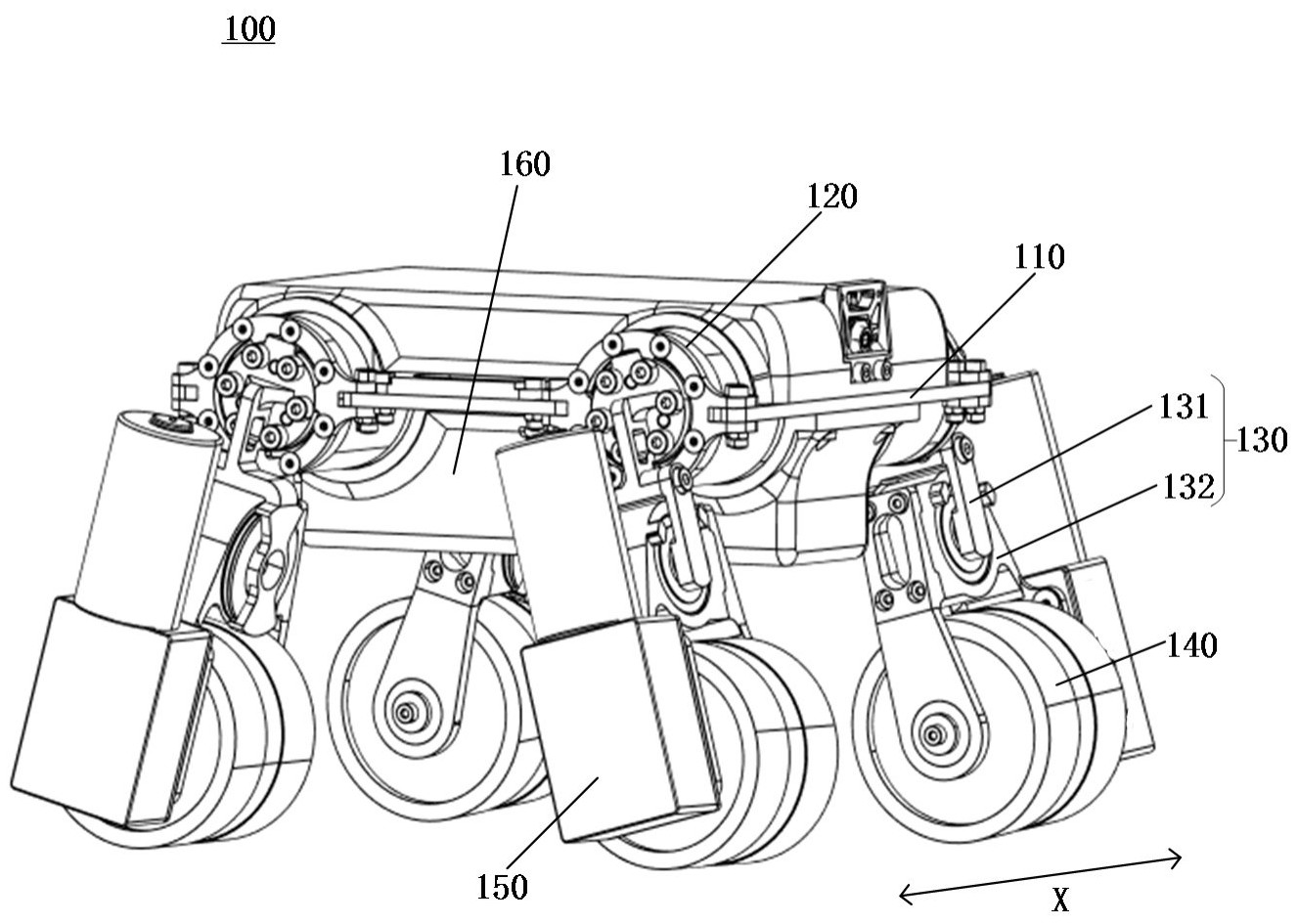
This application provides a wall-climbing robot, relating to the field of robotics technology, which includes a rectangular frame, multiple driving components, and multiple swing arms. The multiple driving components are arranged circumferentially along the rectangular frame and are respectively fixedly connected to it. The multiple swing arms are drivingly connected to the multiple driving components in a one-to-one correspondence. The driving components are used to adjust the rotation angle of the swing arms relative to the rectangular frame, and the end of each swing arm furthest from the driving component is rotatably connected to a magnetic wheel. Each driving component individually controls its corresponding swing arm, thereby changing the spatial position and posture of the magnetic wheel at the end of the swing arm. Because each magnetic wheel is always independently adjusted to a posture that conforms to the local wall surface, the contact area is maintained at the designed fitting area. This minimizes the attenuation of the adsorption force, thereby reducing the risk of the wall-climbing robot falling off the surface.
Publication No.:
CN122770845A
Publication Date:
2026-09-18
Applicant(s):
澳門大學; University of Macau
Inventor(s):
徐青松;張宸翰;張偉鍵; Xu, Qingsong; Zhang, Chenhan; Zhang, Weijian
Technology Field(s):
運輸 Transport
This application provides a wall-climbing robot, relating to the field of robotics technology, which includes a rectangular frame, multiple driving components, and multiple swing arms. The multiple driving components are arranged circumferentially along the rectangular frame and are respectively fixedly connected to it. The multiple swing arms are drivingly connected to the multiple driving components in a one-to-one correspondence. The driving components are used to adjust the rotation angle of the swing arms relative to the rectangular frame, and the end of each swing arm furthest from the driving component is rotatably connected to a magnetic wheel. Each driving component individually controls its corresponding swing arm, thereby changing the spatial position and posture of the magnetic wheel at the end of the swing arm. Because each magnetic wheel is always independently adjusted to a posture that conforms to the local wall surface, the contact area is maintained at the designed fitting area. This minimizes the attenuation of the adsorption force, thereby reducing the risk of the wall-climbing robot falling off the surface.
Amplifier and quantum bit measurement and control system
放大器及量子位元測控系統
Publication No.:
CN122783024A
Publication Date:
2026-09-18
Applicant(s):
澳門大學; University of Macau
Inventor(s):
彭亞濤;李佳偉;繆怡軒;殷俊;馬許願;麥沛然; Peng, Yatao; Li, Jiawei; Miao, Yixuan; Yin, Jun; Rui Paulo da Silva Martins; Mai, Peiran
Technology Field(s):
基本通訊流程、電腦技術 Basic communication processes, Computer technology
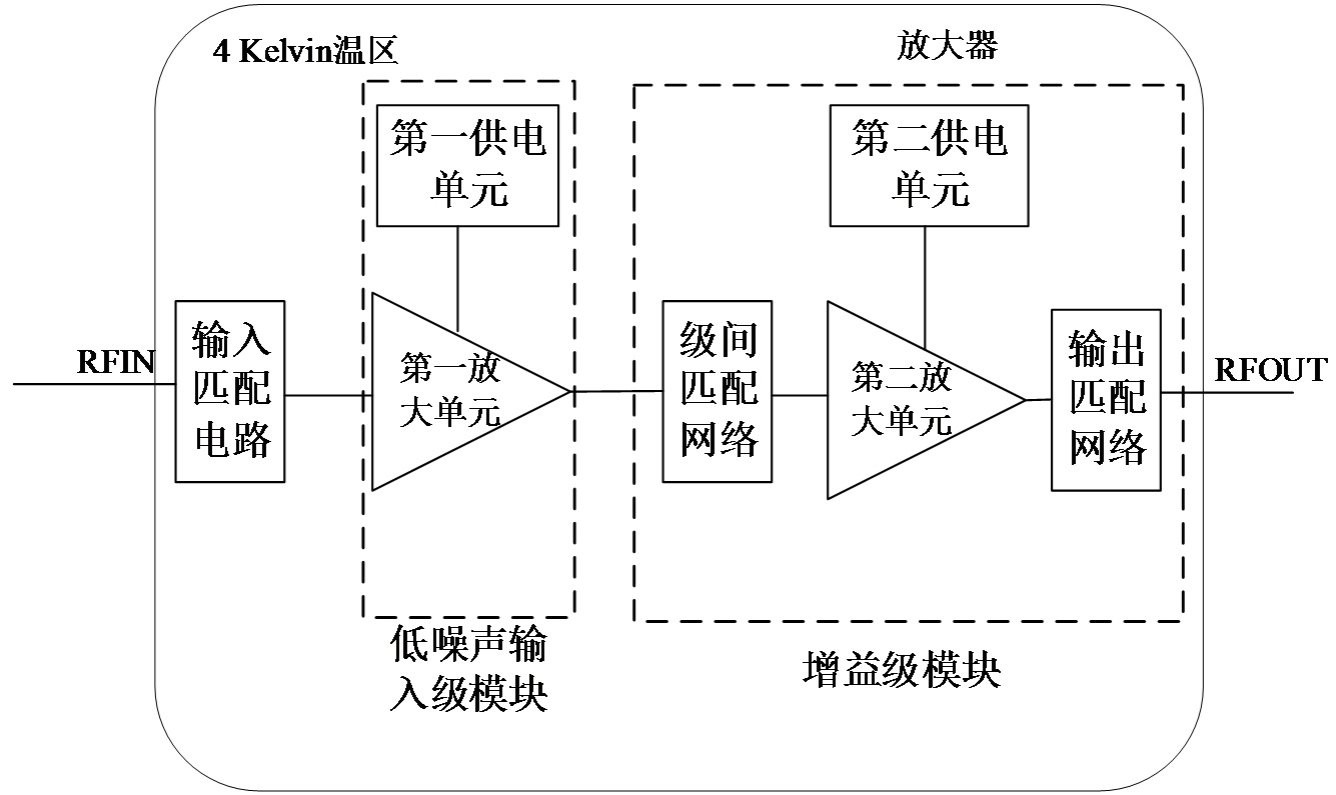
This application provides an amplifier and a qubit measurement and control system, relating to the field of amplifier technology. The amplifier comprises an input matching circuit, a low-noise input stage module, and a gain stage module. The low-noise input stage module includes a first amplification unit and a first power supply unit, and the gain stage module includes a second amplification unit, a second power supply unit, an inter-stage matching circuit, and an output matching circuit. The first power supply unit is configured to supply power to the first amplification unit, and the second power supply unit is configured to supply power to the second amplification unit. By adopting a tightly coupled, integrated architecture of power supply and amplification units, each amplification unit in the amplifier is integrated with its corresponding power supply unit, allowing each power supply unit to directly supply power to its associated amplification unit. When scaling up the number of amplification units to accommodate the readout requirements of large-scale qubit arrays, only the number of parallel, integrated power-amplification units needs to be increased, eliminating the need for additional power interconnects routed across cryogenic stages.
Publication No.:
CN122783024A
Publication Date:
2026-09-18
Applicant(s):
澳門大學; University of Macau
Inventor(s):
彭亞濤;李佳偉;繆怡軒;殷俊;馬許願;麥沛然; Peng, Yatao; Li, Jiawei; Miao, Yixuan; Yin, Jun; Rui Paulo da Silva Martins; Mai, Peiran
Technology Field(s):
基本通訊流程、電腦技術 Basic communication processes, Computer technology
This application provides an amplifier and a qubit measurement and control system, relating to the field of amplifier technology. The amplifier comprises an input matching circuit, a low-noise input stage module, and a gain stage module. The low-noise input stage module includes a first amplification unit and a first power supply unit, and the gain stage module includes a second amplification unit, a second power supply unit, an inter-stage matching circuit, and an output matching circuit. The first power supply unit is configured to supply power to the first amplification unit, and the second power supply unit is configured to supply power to the second amplification unit. By adopting a tightly coupled, integrated architecture of power supply and amplification units, each amplification unit in the amplifier is integrated with its corresponding power supply unit, allowing each power supply unit to directly supply power to its associated amplification unit. When scaling up the number of amplification units to accommodate the readout requirements of large-scale qubit arrays, only the number of parallel, integrated power-amplification units needs to be increased, eliminating the need for additional power interconnects routed across cryogenic stages.
Mixed gas shear system for penetrating biological barriers
用於穿透生物屏障的混合氣體剪下力系統
Publication No.:
CN122750470A
Publication Date:
2026-09-15
Applicant(s):
澳門大學; University of Macau
Inventor(s):
鄭穎;劉子銘;劉暢;田喜東; Zheng, Ying; Liu, Ziming; Liu, Chang; Tian, Xidong
Technology Field(s):
生物技術、醫療技術、製藥 Biotechnology, Medical technology, Pharmaceuticals
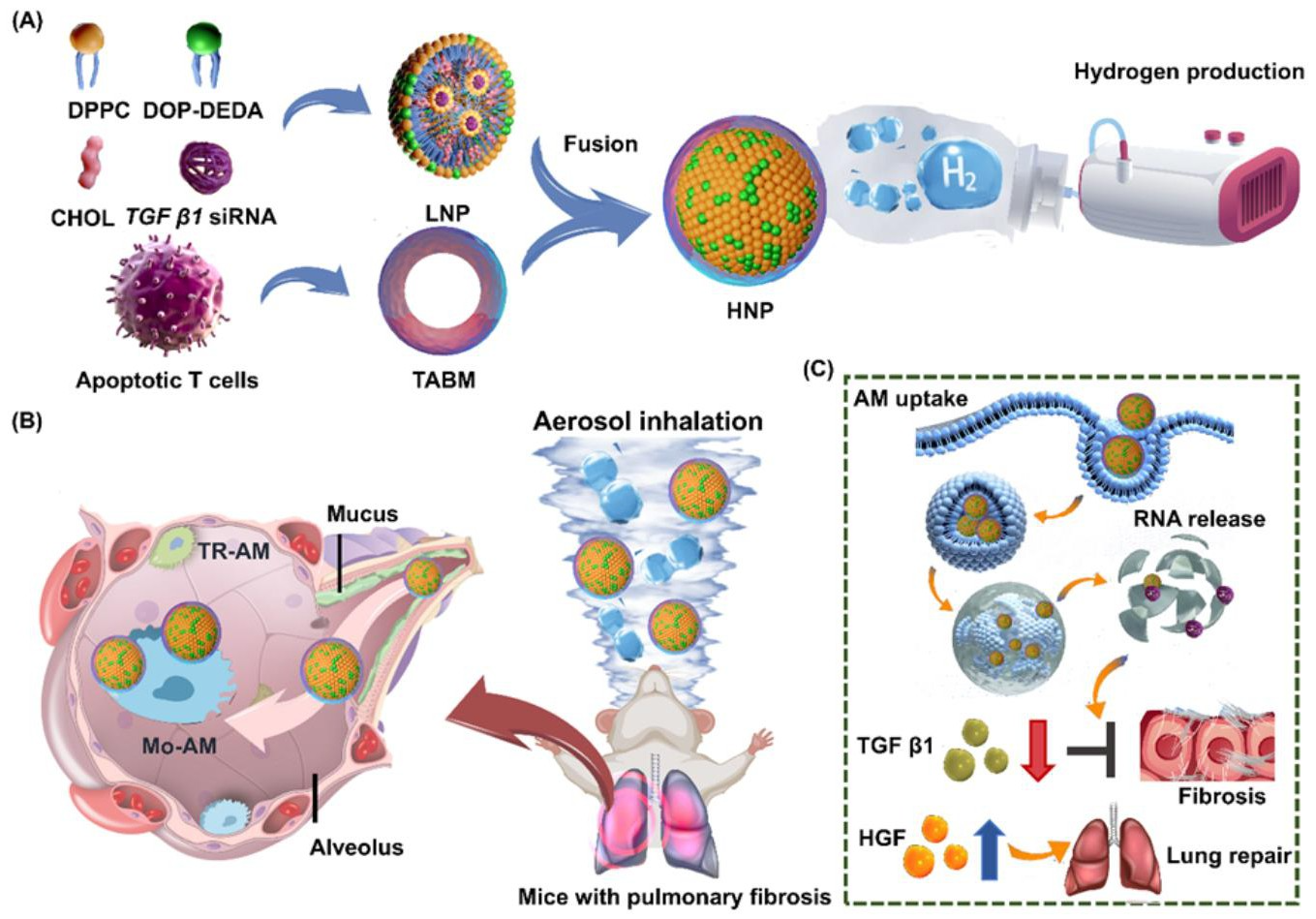
The present invention discloses a mixed-gas shear force system for penetrating biological barriers, relating to the fields of biomedical engineering and drug delivery technology. The invention provides a system and method for disrupting non-Newtonian fluid barriers by applying a shear force field generated by a mixed gas, thereby enhancing therapeutic agent delivery. This technology can be applied to pulmonary drug delivery, utilizing a hydrogen-assisted aerosol inhalation device to deliver biomimetic hybrid nanoparticles encapsulating TGF-β1 siRNA to alveolar macrophages, thereby suppressing pro-fibrotic signaling and promoting lung repair in pulmonary fibrosis. Furthermore, by facilitating the release and diffusion of mRNA across gel-like barriers on tissue samples, the present invention improves mRNA capture efficiency in spatial transcriptomics. Through precise control of gas properties and nanoparticle design, the present invention provides a versatile platform for overcoming biological barriers and enhancing molecular delivery across various biomedical applications.
Publication No.:
CN122750470A
Publication Date:
2026-09-15
Applicant(s):
澳門大學; University of Macau
Inventor(s):
鄭穎;劉子銘;劉暢;田喜東; Zheng, Ying; Liu, Ziming; Liu, Chang; Tian, Xidong
Technology Field(s):
生物技術、醫療技術、製藥 Biotechnology, Medical technology, Pharmaceuticals
The present invention discloses a mixed-gas shear force system for penetrating biological barriers, relating to the fields of biomedical engineering and drug delivery technology. The invention provides a system and method for disrupting non-Newtonian fluid barriers by applying a shear force field generated by a mixed gas, thereby enhancing therapeutic agent delivery. This technology can be applied to pulmonary drug delivery, utilizing a hydrogen-assisted aerosol inhalation device to deliver biomimetic hybrid nanoparticles encapsulating TGF-β1 siRNA to alveolar macrophages, thereby suppressing pro-fibrotic signaling and promoting lung repair in pulmonary fibrosis. Furthermore, by facilitating the release and diffusion of mRNA across gel-like barriers on tissue samples, the present invention improves mRNA capture efficiency in spatial transcriptomics. Through precise control of gas properties and nanoparticle design, the present invention provides a versatile platform for overcoming biological barriers and enhancing molecular delivery across various biomedical applications.
An LDO that takes into account high power supply rejection ratio and fast transient response in entire frequency band
一種兼顧全頻段高電源抑制比與快速瞬態響應的LDO
Publication No.:
CN122756394A
Publication Date:
2026-09-15
Applicant(s):
中國南方電網有限責任公司超高壓輸電公司電力科研院;橫琴粵澳深度合作區澳門大學高等研究院(橫琴澳門大學高等研究院); Electric Power Research Institute, CSG EHV Power Transmission Company; University of Macau Advanced Research Institute in Hengqin (HUMRI)
Inventor(s):
鄧軍;胡柏涵;崔彥捷;周海濱;陳知行;諸嫣;馬許願;潘志城;謝志成;張晉寅;孫勇;伍衡; Deng, Jun; Hu, Bohan; Cui, Yanjie; Zhou, Haibin; Chen, Zhixing; Zhu, Yan; Rui Paulo da Silva Martins; Pan, Zhicheng; Xie, Zhicheng; Zhang, Jinyin; Sun, Yong; Wu, Heng
Technology Field(s):
控制技術 Control
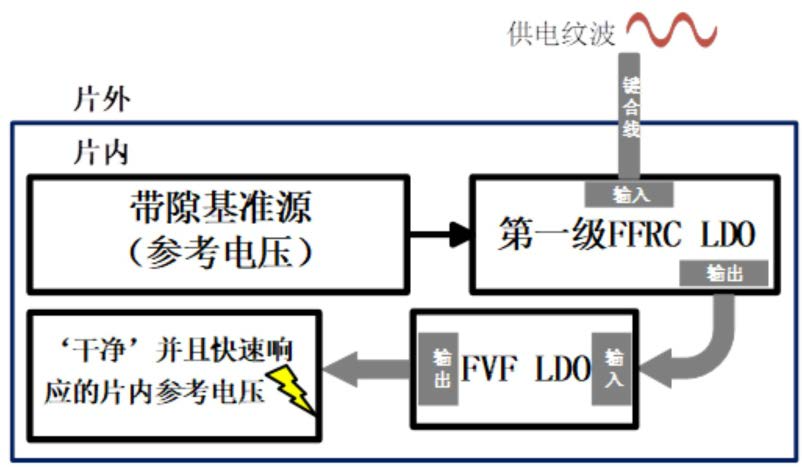
The present invention belongs to the field of integrated circuits and discloses a low-dropout regulator (LDO) that balances high full-band power supply rejection ratio (PSRR) with fast transient response. The LDO comprises a bandgap reference source and a first-stage feedforward ripple cancellation (FFRC) LDO. The reference voltage of the first-stage FFRC LDO is provided by the bandgap reference source, and an off-chip power supply is directly connected to the input node of the on-chip first-stage FFRC LDO via bonding wires. The clean voltage source output from the first-stage FFRC LDO is directly supplied to the input node of a second-stage flipped voltage follower (FVF) LDO, and the second-stage FVF LDO directly outputs a clean, fast-responding on-chip reference voltage. In this two-stage cascaded architecture, the first stage provides high PSRR and primary voltage regulation, while the second stage handles heavy-load driving and fast transient response, thereby achieving complementary performance. By utilizing feedforward ripple cancellation, the full-band PSRR is substantially enhanced—reaching peak values near -110 dB—without sacrificing bandwidth. Furthermore, by maximizing the quiescent current of the FVF LDO within the allowable load current range of the first-stage LDO, the output impedance of the FVF LDO can be reduced to below 10 Ω.
Publication No.:
CN122756394A
Publication Date:
2026-09-15
Applicant(s):
中國南方電網有限責任公司超高壓輸電公司電力科研院;橫琴粵澳深度合作區澳門大學高等研究院(橫琴澳門大學高等研究院); Electric Power Research Institute, CSG EHV Power Transmission Company; University of Macau Advanced Research Institute in Hengqin (HUMRI)
Inventor(s):
鄧軍;胡柏涵;崔彥捷;周海濱;陳知行;諸嫣;馬許願;潘志城;謝志成;張晉寅;孫勇;伍衡; Deng, Jun; Hu, Bohan; Cui, Yanjie; Zhou, Haibin; Chen, Zhixing; Zhu, Yan; Rui Paulo da Silva Martins; Pan, Zhicheng; Xie, Zhicheng; Zhang, Jinyin; Sun, Yong; Wu, Heng
Technology Field(s):
控制技術 Control
The present invention belongs to the field of integrated circuits and discloses a low-dropout regulator (LDO) that balances high full-band power supply rejection ratio (PSRR) with fast transient response. The LDO comprises a bandgap reference source and a first-stage feedforward ripple cancellation (FFRC) LDO. The reference voltage of the first-stage FFRC LDO is provided by the bandgap reference source, and an off-chip power supply is directly connected to the input node of the on-chip first-stage FFRC LDO via bonding wires. The clean voltage source output from the first-stage FFRC LDO is directly supplied to the input node of a second-stage flipped voltage follower (FVF) LDO, and the second-stage FVF LDO directly outputs a clean, fast-responding on-chip reference voltage. In this two-stage cascaded architecture, the first stage provides high PSRR and primary voltage regulation, while the second stage handles heavy-load driving and fast transient response, thereby achieving complementary performance. By utilizing feedforward ripple cancellation, the full-band PSRR is substantially enhanced—reaching peak values near -110 dB—without sacrificing bandwidth. Furthermore, by maximizing the quiescent current of the FVF LDO within the allowable load current range of the first-stage LDO, the output impedance of the FVF LDO can be reduced to below 10 Ω.
A piezoelectric energy harvesting interface based on excitation identification and maximum power point tracking
一種基於激勵識別和最大功率點跟蹤的壓電能量採集介面
Publication No.:
CN122764017A
Publication Date:
2026-09-15
Applicant(s):
澳門大學; University of Macau
Inventor(s):
趙廣澍;桑浩楊;羅文基; Zhao, Guangshu; Sang, Haoyang; Luo, Wenji
Technology Field(s):
電機、設備、能源 Electrical machinery, apparatus, energy
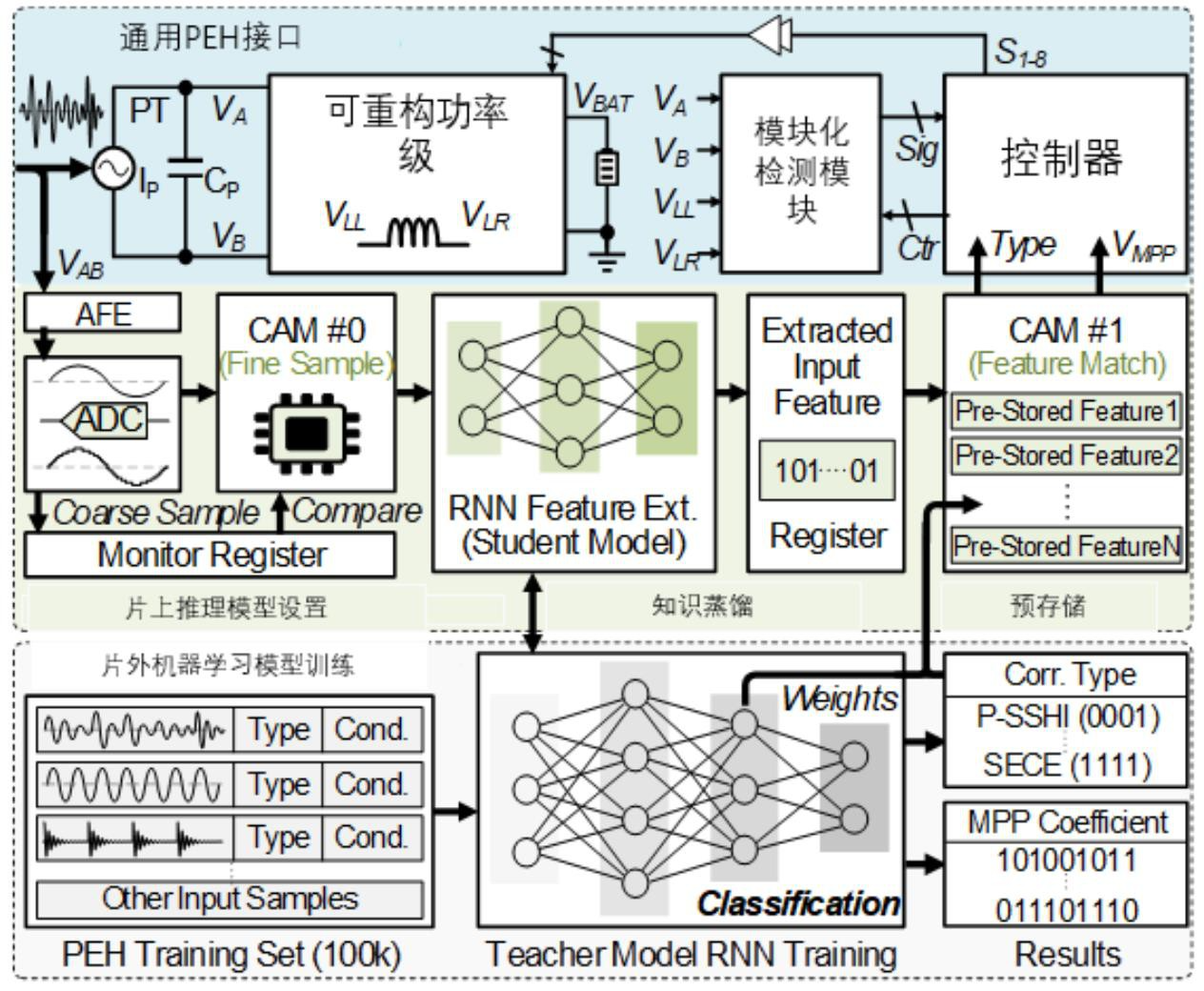
The present application discloses a piezoelectric energy harvesting interface based on excitation identification and maximum power point tracking. The interface includes a piezoelectric transducer, a reconfigurable power stage, an analog conversion module, a storage-and-matching module, a feature extraction engine, a detection module, and a controller. A positive-and-negative polarity vibration voltage is generated by the piezoelectric transducer and converted by the analog conversion module to obtain an input vibration waveform. The controller extracts features from the input vibration waveform via the feature extraction engine to obtain mapped features, which are then matched against the storage-and-matching module. Based on the matching result and a detection signal from the detection module sensing the piezoelectric transducer, the controller generates a control signal. The reconfigurable power stage determines a target topology mode according to the control signal and operates under the target topology mode to perform corresponding energy operations on the piezoelectric transducer. Embodiments of the present application can improve scenario adaptability and energy extraction efficiency, and can be widely applied in the technical field of piezoelectric energy harvesting.
Publication No.:
CN122764017A
Publication Date:
2026-09-15
Applicant(s):
澳門大學; University of Macau
Inventor(s):
趙廣澍;桑浩楊;羅文基; Zhao, Guangshu; Sang, Haoyang; Luo, Wenji
Technology Field(s):
電機、設備、能源 Electrical machinery, apparatus, energy
The present application discloses a piezoelectric energy harvesting interface based on excitation identification and maximum power point tracking. The interface includes a piezoelectric transducer, a reconfigurable power stage, an analog conversion module, a storage-and-matching module, a feature extraction engine, a detection module, and a controller. A positive-and-negative polarity vibration voltage is generated by the piezoelectric transducer and converted by the analog conversion module to obtain an input vibration waveform. The controller extracts features from the input vibration waveform via the feature extraction engine to obtain mapped features, which are then matched against the storage-and-matching module. Based on the matching result and a detection signal from the detection module sensing the piezoelectric transducer, the controller generates a control signal. The reconfigurable power stage determines a target topology mode according to the control signal and operates under the target topology mode to perform corresponding energy operations on the piezoelectric transducer. Embodiments of the present application can improve scenario adaptability and energy extraction efficiency, and can be widely applied in the technical field of piezoelectric energy harvesting.