


Latest UM Patents (2026-07-13)
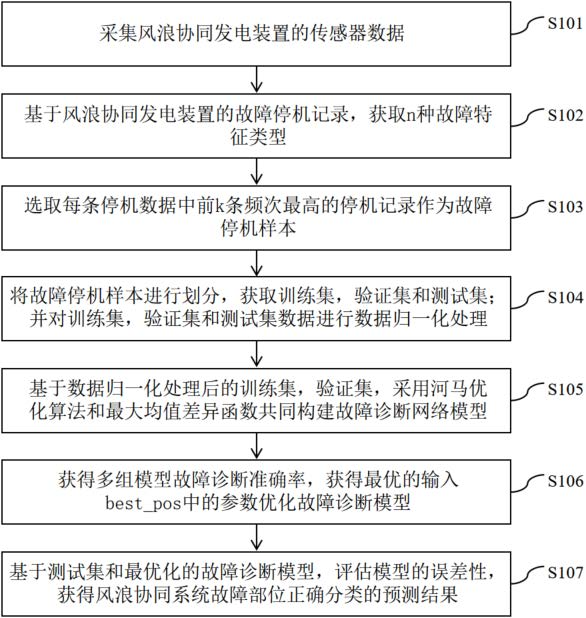
A composite fault diagnosis method for wind and wave collaborative power generation systems based on hippo optimization algorithm and deep migration residual convolutional network
一种基于河马优化算法及深度迁移残差卷积网络的风浪协同发电系统复合故障诊断方法
Publication No.:
CN122346719A
Publication Date:
2026-07-13
Applicant(s):
澳門大學; 昆明理工大學; University of Macau; Kunming University Of Science And Technology
Inventor(s):
王百鍵; 高智江; 趙晶; 那靖; 黃英博; Wang Baijian; Gao Zhijiang; Zhao Jing; Na Jing; Huang Yingbo
Technology Field(s):
電腦技術; 引擎、幫浦、渦輪機; Computer technology; Engines, pumps, turbines
The present invention provides a deep learning model for fault diagnosis in a cross-domain wind–wave hybrid power generation system. The model integrates a transfer learning strategy with a deep residual convolutional neural network architecture optimized using the Hippopotamus Optimization Algorithm (HOA). First, a source-domain fault dataset covering multiple operating conditions is constructed. Key fault features are extracted from the dataset using deep learning techniques, and an efficient fault diagnosis model is trained. Second, in view of the potential scarcity of target-domain data, Maximum Mean Discrepancy (MMD) is employed to quantify differences between the fault feature distributions of the source and target domains, thereby enhancing the model’s cross-domain diagnostic capability. Furthermore, HOA is used to optimize the hyperparameters of the fault diagnosis model, effectively improving its generalization capability and diagnostic accuracy in the target domain. Finally, the diagnostic performance of the proposed fault diagnosis algorithm is verified through a specific embodiment. The present invention provides a novel technical approach to practical fault diagnosis for wind–wave hybrid power generation systems, thereby improving fault diagnosis accuracy and reducing system downtime caused by faults.
Publication No.:
CN122346719A
Publication Date:
2026-07-13
Applicant(s):
澳門大學; 昆明理工大學; University of Macau; Kunming University Of Science And Technology
Inventor(s):
王百鍵; 高智江; 趙晶; 那靖; 黃英博; Wang Baijian; Gao Zhijiang; Zhao Jing; Na Jing; Huang Yingbo
Technology Field(s):
電腦技術; 引擎、幫浦、渦輪機; Computer technology; Engines, pumps, turbines
The present invention provides a deep learning model for fault diagnosis in a cross-domain wind–wave hybrid power generation system. The model integrates a transfer learning strategy with a deep residual convolutional neural network architecture optimized using the Hippopotamus Optimization Algorithm (HOA). First, a source-domain fault dataset covering multiple operating conditions is constructed. Key fault features are extracted from the dataset using deep learning techniques, and an efficient fault diagnosis model is trained. Second, in view of the potential scarcity of target-domain data, Maximum Mean Discrepancy (MMD) is employed to quantify differences between the fault feature distributions of the source and target domains, thereby enhancing the model’s cross-domain diagnostic capability. Furthermore, HOA is used to optimize the hyperparameters of the fault diagnosis model, effectively improving its generalization capability and diagnostic accuracy in the target domain. Finally, the diagnostic performance of the proposed fault diagnosis algorithm is verified through a specific embodiment. The present invention provides a novel technical approach to practical fault diagnosis for wind–wave hybrid power generation systems, thereby improving fault diagnosis accuracy and reducing system downtime caused by faults.
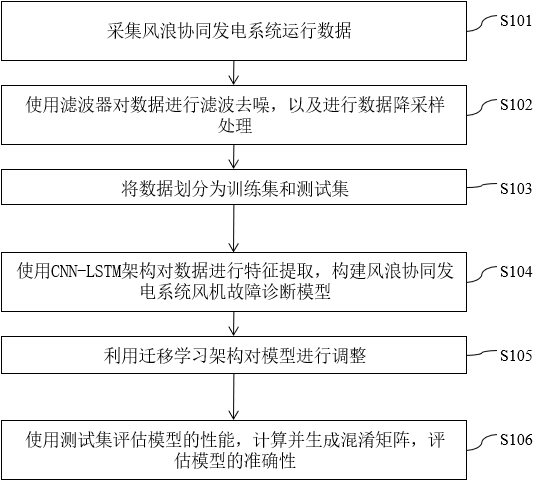
An intelligent diagnosis method for wind and wave power generation composite faults based on CNN-LSTM and transfer learning
一种基于CNN-LSTM和迁移学习的风浪发电复合故障智能诊断方法
Publication No.:
CN122346720A
Publication Date:
2026-07-13
Applicant(s):
珠海澳大科技研究院;澳門大學; Zhuhai UM Science & Technology Research Institute (ZUMRI); University of Macau
Inventor(s):
王百鍵;周復求;趙晶;高智江; Wang Baijian; Zhou Fuqiu; Zhao Jing; Gao Zhijiang
Technology Field(s):
電腦技術 Computer technology
The present invention discloses a compound fault diagnosis method for a wind–wave hybrid power generation system. The method integrates a convolutional neural network (CNN), a long short-term memory network (LSTM), and transfer learning to address challenges in weak-signal identification, compound-fault decoupling, and intelligent diagnosis across varying operating conditions under complex and low signal-to-noise-ratio conditions. The CNN extracts local features from vibration signals, while the LSTM captures long-term dependencies in time-series data, thereby enhancing weak-signal identification. A dual-channel CNN–LSTM architecture enables accurate identification and separation of compound fault patterns. Furthermore, a feature-transfer learning strategy enables the model to maintain high diagnostic accuracy under different operating conditions, thereby improving its adaptability and robustness to changes in such conditions. The method significantly improves the accuracy and efficiency of fault diagnosis for wind–wave hybrid power generation systems and is suitable for real-time monitoring and maintenance thereof.
Publication No.:
CN122346720A
Publication Date:
2026-07-13
Applicant(s):
珠海澳大科技研究院;澳門大學; Zhuhai UM Science & Technology Research Institute (ZUMRI); University of Macau
Inventor(s):
王百鍵;周復求;趙晶;高智江; Wang Baijian; Zhou Fuqiu; Zhao Jing; Gao Zhijiang
Technology Field(s):
電腦技術 Computer technology
The present invention discloses a compound fault diagnosis method for a wind–wave hybrid power generation system. The method integrates a convolutional neural network (CNN), a long short-term memory network (LSTM), and transfer learning to address challenges in weak-signal identification, compound-fault decoupling, and intelligent diagnosis across varying operating conditions under complex and low signal-to-noise-ratio conditions. The CNN extracts local features from vibration signals, while the LSTM captures long-term dependencies in time-series data, thereby enhancing weak-signal identification. A dual-channel CNN–LSTM architecture enables accurate identification and separation of compound fault patterns. Furthermore, a feature-transfer learning strategy enables the model to maintain high diagnostic accuracy under different operating conditions, thereby improving its adaptability and robustness to changes in such conditions. The method significantly improves the accuracy and efficiency of fault diagnosis for wind–wave hybrid power generation systems and is suitable for real-time monitoring and maintenance thereof.
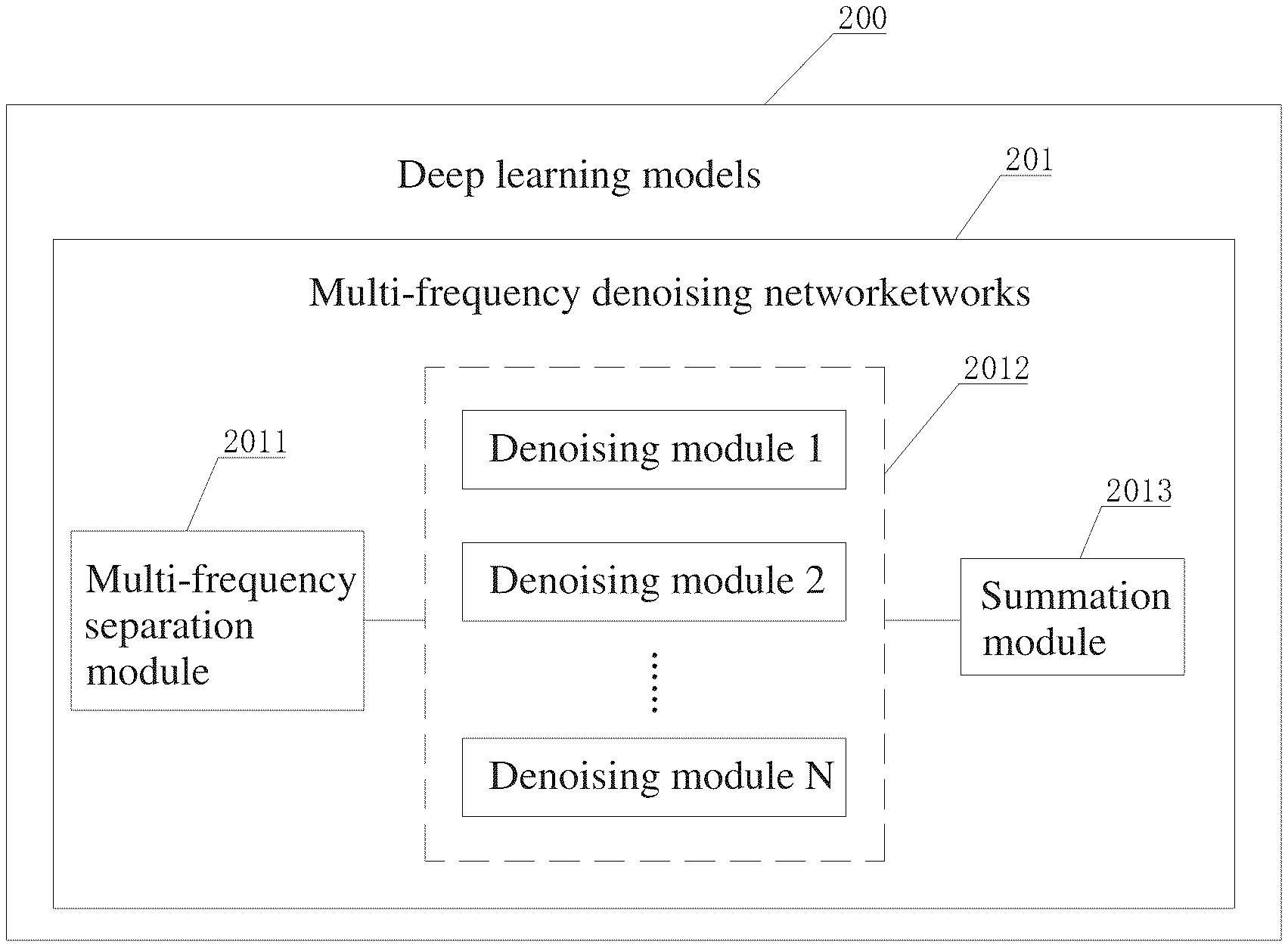
Image denoising method, electronic device and storage medium [Granted Patent]
影像去雜訊方法、電子裝置及儲存媒體 [授權專利]
Publication No.:
US12675849B2
Publication Date:
2026-07-13
Applicant(s):
澳門大學; University of Macau
Inventor(s):
Seng Peng Mok; Yu Du
Technology Field(s):
電腦技術 Computer technology
The present disclosure discloses an image denoising method, an electronic device and a storage medium, the method including : acquiring a preset quantity of full dose images and low dose images; training a preset deep learning model according to the full dose images and the low dose images, wherein the deep learning model includes a multi-frequency band denoising network, and the multi-frequency band denoising network includes one multi-frequency band separation module, N denoising modules and one summation module; and acquiring an image to be denoised, and denoising the image to be denoised through the multi-frequency band denoising network in a trained deep learning model.
Publication No.:
US12675849B2
Publication Date:
2026-07-13
Applicant(s):
澳門大學; University of Macau
Inventor(s):
Seng Peng Mok; Yu Du
Technology Field(s):
電腦技術 Computer technology
The present disclosure discloses an image denoising method, an electronic device and a storage medium, the method including : acquiring a preset quantity of full dose images and low dose images; training a preset deep learning model according to the full dose images and the low dose images, wherein the deep learning model includes a multi-frequency band denoising network, and the multi-frequency band denoising network includes one multi-frequency band separation module, N denoising modules and one summation module; and acquiring an image to be denoised, and denoising the image to be denoised through the multi-frequency band denoising network in a trained deep learning model.
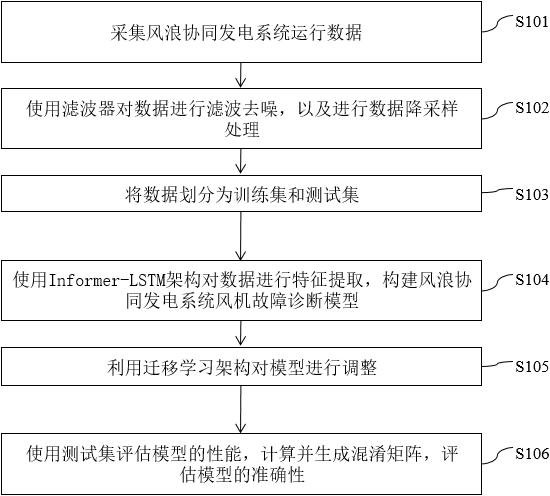
An intelligent diagnosis method for wind and wave power generation composite faults based on Information-LSTM and transfer learning
一种基于Informer-LSTM和迁移学习的风浪发电复合故障智能诊断方法
Publication No.:
CN122364846A
Publication Date:
2026-07-13
Applicant(s):
珠海澳大科技研究院;澳門大學; Zhuhai UM Science & Technology Research Institute (ZUMRI); University of Macau
Inventor(s):
王百鍵;周復求;趙晶;高智江; Wang Baijian; Zhou Fuqiu; Zhao Jing; Gao Zhijiang
Technology Field(s):
電腦技術; 引擎、幫浦、渦輪機; Computer technology; Engines, pumps, turbines
The present invention discloses an intelligent diagnostic method for compound faults in wind-wave power generation based on Informer-LSTM and transfer learning. The method collects multisensor data from a wind-wave hybrid power generation system and, after preprocessing, employs a hybrid Informer-LSTM architecture for feature extraction and pattern recognition. Informer uses a ProbSparse self-attention mechanism to efficiently capture long-term dependencies in long sequences, thereby significantly reducing computational complexity; LSTM focuses on local temporal features to enhance recognition of weak signals. The combination of the two enables effective decoupling and accurate diagnosis of compound faults. To address the challenges of small sample sizes and cross-operating-condition generalization, the present invention introduces a transfer learning mechanism. A base model is first pre-trained using large-scale data from a source domain, then transferred to a target domain and fine-tuned using a small amount of labeled data. Maximum Mean Discrepancy (MMD)-based domain adaptation is further incorporated to optimize distribution alignment. The method demonstrates high accuracy, strong robustness, and good generalization capability in complex marine environments, and is applicable to real-time intelligent fault diagnosis, operation, and maintenance of wind-wave hybrid power generation systems, thereby offering significant engineering application value.
Publication No.:
CN122364846A
Publication Date:
2026-07-13
Applicant(s):
珠海澳大科技研究院;澳門大學; Zhuhai UM Science & Technology Research Institute (ZUMRI); University of Macau
Inventor(s):
王百鍵;周復求;趙晶;高智江; Wang Baijian; Zhou Fuqiu; Zhao Jing; Gao Zhijiang
Technology Field(s):
電腦技術; 引擎、幫浦、渦輪機; Computer technology; Engines, pumps, turbines
The present invention discloses an intelligent diagnostic method for compound faults in wind-wave power generation based on Informer-LSTM and transfer learning. The method collects multisensor data from a wind-wave hybrid power generation system and, after preprocessing, employs a hybrid Informer-LSTM architecture for feature extraction and pattern recognition. Informer uses a ProbSparse self-attention mechanism to efficiently capture long-term dependencies in long sequences, thereby significantly reducing computational complexity; LSTM focuses on local temporal features to enhance recognition of weak signals. The combination of the two enables effective decoupling and accurate diagnosis of compound faults. To address the challenges of small sample sizes and cross-operating-condition generalization, the present invention introduces a transfer learning mechanism. A base model is first pre-trained using large-scale data from a source domain, then transferred to a target domain and fine-tuned using a small amount of labeled data. Maximum Mean Discrepancy (MMD)-based domain adaptation is further incorporated to optimize distribution alignment. The method demonstrates high accuracy, strong robustness, and good generalization capability in complex marine environments, and is applicable to real-time intelligent fault diagnosis, operation, and maintenance of wind-wave hybrid power generation systems, thereby offering significant engineering application value.
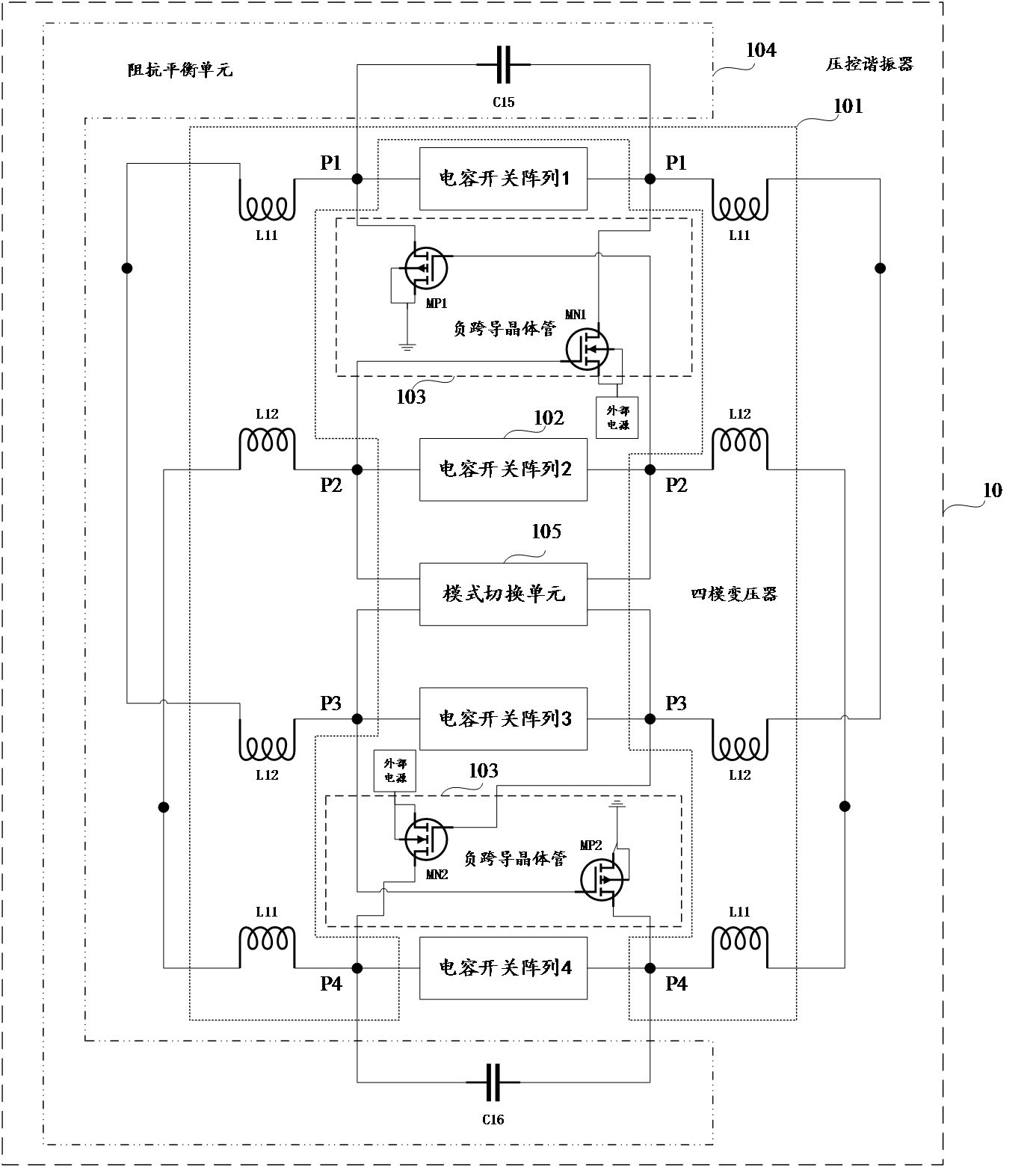
Harmonic self-aligned voltage-controlled resonators and frequency synthesizers
谐波自对齐的压控谐振器以及频率合成器
Publication No.:
CN122371923A
Publication Date:
2026-07-13
Applicant(s):
澳門大學; University of Macau
Inventor(s):
吴悦; 彭亚涛; 殷俊; 马许愿; 麦沛然; Wu Yue; Peng Yatao; Yin Jun; Ma Xuyuan; Mai Peiran
Technology Field(s):
基本通訊流程 Basic communication processes
The present application provides a harmonically self-aligned voltage-controlled oscillator and a frequency synthesizer, belonging to the field of resonator technology. Each port of a four-mode transformer is coupled to a respective switched-capacitor array to maintain capacitance symmetry among the ports. One set of negative-transconductance transistors is connected between the first and second ports of the four-mode transformer, and another set is connected between the third and fourth ports. The negative-transconductance circuitry provides negative resistance to compensate for losses in the four-mode transformer. Capacitors in an impedance-balancing unit are respectively connected across the first and fourth ports to balance the impedances of the ports of the four-mode transformer. A mode-switching unit is connected between the second and third ports to control switching of the local-oscillator modes of the four-mode transformer. The present application simplifies phase-locked-loop design in quantum-bit measurement-and-control systems, improves phase-noise performance in deep-cryogenic environments, and provides a reliable local-oscillator signal source.
Publication No.:
CN122371923A
Publication Date:
2026-07-13
Applicant(s):
澳門大學; University of Macau
Inventor(s):
吴悦; 彭亚涛; 殷俊; 马许愿; 麦沛然; Wu Yue; Peng Yatao; Yin Jun; Ma Xuyuan; Mai Peiran
Technology Field(s):
基本通訊流程 Basic communication processes
The present application provides a harmonically self-aligned voltage-controlled oscillator and a frequency synthesizer, belonging to the field of resonator technology. Each port of a four-mode transformer is coupled to a respective switched-capacitor array to maintain capacitance symmetry among the ports. One set of negative-transconductance transistors is connected between the first and second ports of the four-mode transformer, and another set is connected between the third and fourth ports. The negative-transconductance circuitry provides negative resistance to compensate for losses in the four-mode transformer. Capacitors in an impedance-balancing unit are respectively connected across the first and fourth ports to balance the impedances of the ports of the four-mode transformer. A mode-switching unit is connected between the second and third ports to control switching of the local-oscillator modes of the four-mode transformer. The present application simplifies phase-locked-loop design in quantum-bit measurement-and-control systems, improves phase-noise performance in deep-cryogenic environments, and provides a reliable local-oscillator signal source.

Use of Konjac Glucomannan and Derivative Thereof, Glucomannan Caprylate, Nanoparticles and Coating Obtained from Glucomannan Caprylate, Preparation Method for Nanoparticles, and Use of Glucomannan Caprylate, Nanoparticles or Coating
魔芋葡甘聚醣及其衍生物的用途、葡甘聚醣辛酸鹽、由葡甘聚醣辛酸鹽獲得的奈米顆粒和塗層、奈米顆粒的製備方法及其用途
Publication No.:
EP4772202A1
Publication Date:
2026-07-13
Applicant(s):
澳門大學; University of Macau
Inventor(s):
Wang, Chunming; Liu, Yu; Zhang, Zhe
Technology Field(s):
醫療技術 Medical technology
A use of konjac glucomannan and a derivative thereof, glucomannan caprylate, nanoparticles and a coating obtained from the glucomannan caprylate, a preparation method for the nanoparticles, and a use of the glucomannan caprylate, the nanoparticles or the coating, relating to the technical field of medicine and material chemistry. The konjac glucomannan and the derivative thereof can be used as extracellular matrix fillers, and glucomannan caprylate obtained by modifying the konjac glucomannan by means of an esterification reaction, and nanoparticles or a glucomannan caprylate coating further obtained from the glucomannan caprylate can both be used for preparing drugs or materials for regulating functions of nucleus pulposus cells, and in particular, can be used for preparing drugs or materials for relieving or treating intervertebral disc degeneration. The glucomannan caprylate has the characteristics of being non-toxic, easily available and highly histocompatible, and can be prepared into different dosage forms according to requirements. The present disclosure provides a novel idea to improve the microenvironment of intervertebral disc degeneration, and also provides a novel use of a biomaterial based on a polysaccharide derivative.
Publication No.:
EP4772202A1
Publication Date:
2026-07-13
Applicant(s):
澳門大學; University of Macau
Inventor(s):
Wang, Chunming; Liu, Yu; Zhang, Zhe
Technology Field(s):
醫療技術 Medical technology
A use of konjac glucomannan and a derivative thereof, glucomannan caprylate, nanoparticles and a coating obtained from the glucomannan caprylate, a preparation method for the nanoparticles, and a use of the glucomannan caprylate, the nanoparticles or the coating, relating to the technical field of medicine and material chemistry. The konjac glucomannan and the derivative thereof can be used as extracellular matrix fillers, and glucomannan caprylate obtained by modifying the konjac glucomannan by means of an esterification reaction, and nanoparticles or a glucomannan caprylate coating further obtained from the glucomannan caprylate can both be used for preparing drugs or materials for regulating functions of nucleus pulposus cells, and in particular, can be used for preparing drugs or materials for relieving or treating intervertebral disc degeneration. The glucomannan caprylate has the characteristics of being non-toxic, easily available and highly histocompatible, and can be prepared into different dosage forms according to requirements. The present disclosure provides a novel idea to improve the microenvironment of intervertebral disc degeneration, and also provides a novel use of a biomaterial based on a polysaccharide derivative.